



CLJA: What Happened, Why It Stalled, and What Changed April 20, 2026
Contents

Part 1: What Happened at Camp Lejeune
From approximately 1953 through 1987, the drinking water at Marine Corps Base Camp Lejeune, North Carolina was contaminated with toxic chemicals. The two primary water treatment systems — at Tarawa Terrace and Hadnot Point — delivered water containing trichloroethylene (TCE), perchloroethylene (PCE), benzene, and vinyl chloride.[1]
The Agency for Toxic Substances and Disease Registry (ATSDR) estimated that more than one million people may have been exposed during this period, including active-duty Marines and Navy personnel, family members, civilian employees, and contractors.[2]
The ATSDR identified specific diseases linked to the contamination, including non-Hodgkin’s lymphoma, leukemia, bladder cancer, kidney cancer, multiple myeloma, Parkinson’s disease, and neurobehavioral effects in children exposed in utero.[2]
Prior to the CLJA, Camp Lejeune claims brought under the Federal Tort Claims Act were dismissed on three independent grounds: (1) North Carolina’s ten-year statute of repose, which barred injury claims accruing more than ten years after the act or omission giving rise to the action; (2) the FTCA’s discretionary function exception, 28 U.S.C. § 2680(a), which preserved the government’s immunity for conduct involving an element of judgment or choice; and (3) the Feres doctrine, which bars tort claims incident to military service. The CLJA addressed all three: it waived the relevant immunity, barred use of North Carolina’s statute of repose as a defense, and created an explicit exception to Feres permitting suits by veterans and civilian employees harmed by the contaminated water.[3]
Part 2: The Law — What Congress Created
The Camp Lejeune Justice Act (CLJA) was enacted as Section 3 of the Sergeant First Class Heath Robinson Honoring our Promise to Address Comprehensive Toxics (PACT) Act of 2022, signed into law on August 10, 2022.[4]
The statute established a waiver of sovereign immunity for CLJA claims and created a specific procedural structure. Under 28 U.S.C. § 2675, claimants must first file an administrative claim with the Department of the Navy before filing suit in federal court. The statute was designed so that the administrative process serves as the primary resolution mechanism, with federal litigation as a fallback for claims not resolved administratively.
To file an administrative claim with the Navy, a claimant must generally satisfy two substantive requirements: (1) have been present at Camp Lejeune for at least 30 days between August 1, 1953 and December 31, 1987; and (2) have a qualifying injury causally linked to the contaminated water. The administrative claim is the starting point — it does not require any intention to file suit. The third requirement, administrative exhaustion under 28 U.S.C. § 2675, applies only to federal court jurisdiction: a claimant may not file a lawsuit until the administrative claim has been presented to the Navy and either denied or left unresolved for six months. The vast majority of the more than 409,000 claims filed are still waiting for an offer through the administrative process.
The Navy established a Claims Management Portal (clclaims.jag.navy.mil) operated by the Camp Lejeune Claims Unit (CLCU) at Washington Navy Yard to receive and process administrative claims.[5]
Part 3: The Elective Option — Design, Requirements, and Constraints
A. What the Elective Option Provides
On September 6, 2023, the Department of Justice and the Department of the Navy published the Public Guidance on the Elective Option (EO) for CLJA Claims, updated September 15, 2023, with an FAQ updated January 16, 2024.[6] By that date, more than 93,000 administrative claims had been filed with the Navy.
The Elective Option is a voluntary settlement framework in which a claimant may accept a preset payment amount determined by disease category and duration of exposure. The EO organized qualifying conditions into two tiers based on ATSDR evidence classifications:
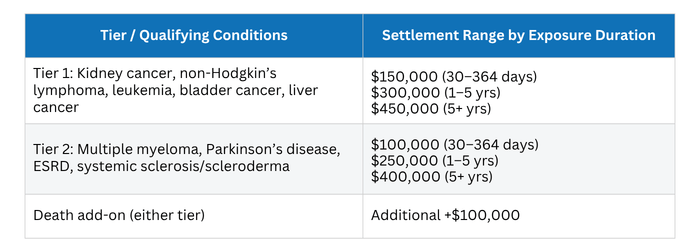
Per the EO guidance, payments are not offset by prior VA disability compensation and do not affect ongoing VA disability payments or healthcare eligibility. Accepting an EO offer is a voluntary, irrevocable waiver of the right to file a private lawsuit.[6]
B. The Proof-of-Presence Requirement
The EO guidance states explicitly: “For purposes of the EO, secondary evidence, such as a sworn affidavit, statement, or declaration, is not sufficient to show a claimant resided or worked at Camp Lejeune because such evidence is less reliable than primary documentation.”[6]
Three independent requirements must all be satisfied for EO eligibility: (1) a qualifying disease in Tier 1 or Tier 2; (2) a diagnosis within the applicable latency period — at least two years after first exposure but no more than 35 years after last exposure; and (3) documentary evidence of presence at Camp Lejeune for at least 30 days during the contamination period.[6]
The EO guidance further requires that a claimant must have been diagnosed before August 10, 2022. Claimants with multiple qualifying diseases may only receive compensation for one condition.[6]
C. The Documentation Gap: Two Cohorts, One System
The contamination period spans 1953 to 1987 — but not all service records from that era are equal. Military service numbers were used through 1970. Social Security numbers replaced them beginning in 1971. That transition created two fundamentally different documentation realities for claimants within the same contamination window:
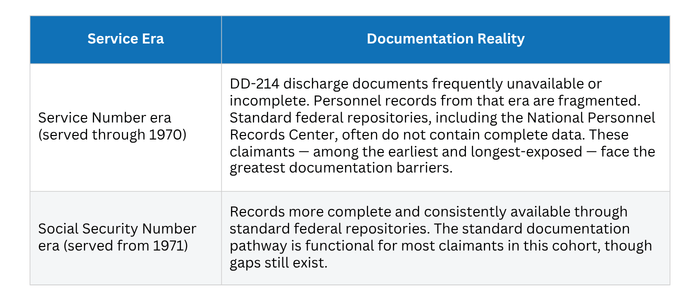
For the pre-1971 cohort, standard military records are often simply not there. The Navy’s own official guidance acknowledged this reality directly. Where standard records exist, they are primary. But the guidance stated that for many claimants they will not be enough: “While standard military records are primary, creative, secondary documentation is often necessary to fill gaps or establish long-term exposure.” The guidance then listed what that means in practice — dated personal photographs with identifiable Camp Lejeune landmarks or base housing in the background, child vaccination records from the naval hospital, baptismal certificates, a spouse’s base employment records, base library cards, bowling alley punch cards, marina rental receipts, and letters or postcards sent to a specific street address within Camp Lejeune.[7]
This was not informal guidance. It was the Navy’s official acknowledgment, published on its own CLJA claims page, that for a substantial portion of the pre-1971 claimant population, the records the law assumed would exist simply do not — and that claimants would need to reconstruct their presence from whatever they could find.
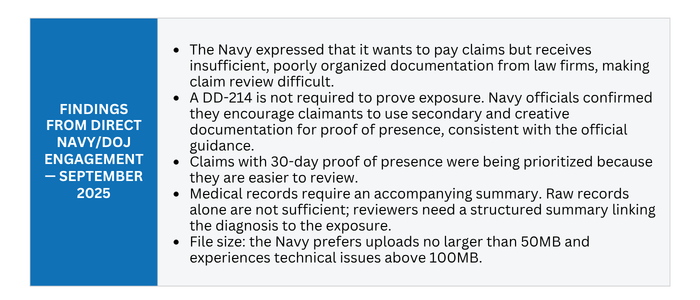
D. What Direct Engagement With Navy and DOJ Officials Confirmed (September 2025)
In September 2025, direct meetings with Navy and Department of Justice officials — including Commander Garrett Snow and Danielle Porcelli Bianchi of the U.S. Navy and Bridget Bailey Lipscomb and Adam Bain of the U.S. Department of Justice — produced the following operational information:[8]
E. The Scale of the Eligibility Constraint
The numbers tell the story directly. As of April 2026, more than 409,000 administrative claims have been filed with the Department of the Navy.[9] Of those, approximately 64,000 fall within the scope of possible EO consideration — meaning they involve a disease category and service history that places them in the EO window. That is roughly 16% of the total filed population. But meeting the disease and service criteria is only the first filter.
Of those 409,000+ claims, approximately 185,000 include at least one supporting document. Approximately 13,000 contain at least three supporting documents and allege a qualifying injury type. That is roughly 3% of the total administrative claims inventory that currently fits within the government’s early settlement framework — not because the remaining 97% lack injury or exposure, but because they current lack the documentation to demonstrate it to the standard the EO requires.[9]
Estimates derived from PLG and DOJ joint status reports suggest approximately 12–13% of claimants satisfy the EO disease criteria and latency requirements at a screening level.[10] Within that group, a further subset has documentary evidence sufficient to establish proof of presence.
The gap between the number of people who were exposed at Camp Lejeune and the number who can currently prove it — to the standard required for a settlement offer — is the defining structural feature of this litigation.
Part 4: The Litigation Structure — What Was Adopted and What Was Not
A. The Litigation Management Platform vs. a Plaintiffs’ Database
Early in the Camp Lejeune litigation, the Court pointed to the September 11th Victim Compensation Fund as the organizational model — specifically, its centralized claimant database. That database did not simply store names. It enabled the Fund to proactively identify eligible claimants, categorize claims by injury type, track documentation status across the full claimant population, and generate the systematic data needed to process claims at scale.[11]
That kind of system was never adopted for Camp Lejeune as the systemwide tool for moving claims through the Navy’s administrative process. What exists on the litigation side is a court-adopted Litigation Management Platform used for a narrower purpose: generating and filing Short Form Complaints in federal court. A Short Form Complaint (SFC) is a simplified lawsuit form that allows a claimant moving into federal court litigation to proceed under the Court’s Camp Lejeune litigation structure without drafting a full individual complaint from scratch.
The Court’s SFC filing instructions make that limited role clear. CMO No. 2 provided that any plaintiff who had already filed a complaint and wished to proceed under the Court’s order, including the Discovery and Trial Plan, “shall file a Short Form Complaint in the Plaintiff’s individual docket.” The Order Adopting Litigation Management Database then directed plaintiffs filing SFCs after November 20, 2023 to use the platform to “populate, generate, and download Short Form Complaints for filing” with the Court.[12]
The mismatch was significant. The CLJA required an administrative-first process, but the public-facing technology pointed lawyers toward litigation filing. The PLG-maintained public litigation website described the platform as the “Camp Lejeune Plaintiffs’ Database,” while the first listed requirement for access was execution of the Participation Agreement and Protective Order. The Participation Agreement included a potential 3% common benefit assessment on recoveries, subject to Court approval.[13]
The SFC filing instructions underscore the distinction: this was a court filing process, not administrative claim submission. The “Point of No Return” warning made that clear. Once a claimant filed an SFC, the claimant was moving from the Navy’s administrative process into federal court litigation.[14]
Not just a formality: For claimants and their lawyers, filing in the courts leapfrogs over the administrative process and puts the case into a queue to wait for a trial date/settlement in federal court. The Litigation Management Platform warns claimants with the following warning before submission:
The "Point of No Return" screen is presented. Notice the red Attention!!
The administrative claims process — through which the vast majority of the 409,000+ claimants are proceeding — operates through the Navy’s Claims Management Portal at clclaims.jag.navy.mil. The Portal is a submission tool: claimants and their attorneys use it to file claims and upload supporting documents. It is not a tracking or analysis system capable of identifying which claimants are eligible, what documentation they are missing, or how to proactively reach them. It does not integrate with the litigation platform. [15]
The practical consequence is that 3+ years after enactment of the CLJA, there is no unified view of the Camp Lejeune claimant population required for coordinated settlement.
B. The Common Benefit Framework — Structure, Scope, and the Administrative Track
Common benefit arrangements serve a legitimate purpose in mass tort litigation. When a Plaintiff Leadership Group invests heavily in shared litigation infrastructure — depositions, expert witnesses, bellwether trial preparation, global settlement negotiations — every attorney whose client benefits from that work contributes proportionally through a holdback. The doctrine prevents one attorney from riding for free on another’s investment.
The PLG in this litigation was appointed by the Court under Case Management Order No. 1 for the purposes of coordinating the litigation before the court. Per court filings and CMO-related orders, the PLG’s defined functions are litigation-side: organizing discovery, coordinating depositions, preparing bellwether trial cases, and participating in settlement negotiations for cases filed in federal court.[13]
The CLJA, however, was written as an administrative-first statute. Claimants must exhaust the Navy administrative process under 28 U.S.C. § 2675 before filing suit. That means the primary resolution pathway — the one Congress designed, the one serving more than 400,000 claimants — operates entirely outside the PLG’s defined role. Individual claimant attorneys handled every step of the administrative process for their clients: signing the client, gathering records, filing the claim, substantiating presence and injury, and evaluating any offer received. That work was done within the statutory fee cap of 28 U.S.C. § 2678, which limits attorney fees to 20% of any administrative settlement.[14]
The drafters of the Participation Agreement appear to have recognized this distinction. Section I.A.4 expressly carves out cases settled with the Department of the Navy pursuant to the Elective Option public guidance as it existed on September 15, 2023 — an implicit acknowledgment that those administrative settlements did not benefit from PLG’s litigation work. No court order has extended common benefit obligations to the administrative track. No CMO has designated the administrative process as within the PLG’s scope.[15]
A Common Benefit Attorney Participation Agreement was filed as Document 31-3. It imposes a 3% holdback on the gross monetary recovery of covered claims. The precise allocation of that assessment between fees and costs is to be proposed by Plaintiffs’ Leadership and approved by the Court prior to any disbursement from the holdback fund. The agreement covers “all claims or actions pursuant to the CLJA in which Participating Counsel hold a fee interest, including unfiled and tolled claims,” subject to the EO carve-out and any further court orders.[15]
C. The Questionnaire Order and Platform Access
Access to the litigation management platform was, at points in this litigation, conditioned on executing the Common Benefit Participation Agreement. Communications to attorneys described access to the platform as access to a “Plaintiffs’ Database.” No court order designates the platform in that capacity or authorizes its use in the administrative claims process in that role.[12]
On October 23, 2025, Magistrate Judge James E. Gates entered an Order (Document 652) governing the questionnaire process. That Order stated:[16]
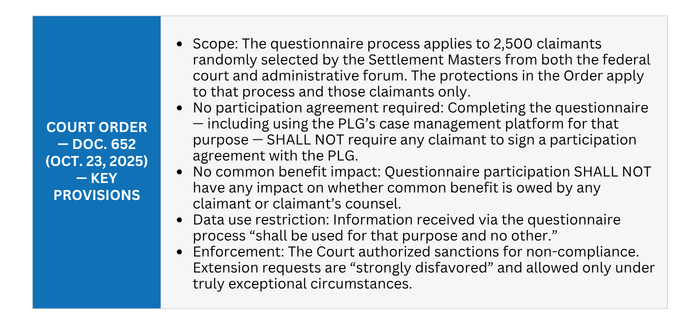
The Order’s protections are expressly limited to the 2,500 randomly selected questionnaire participants and to the questionnaire process itself. The Order does not address the application of the common benefit framework to claimants outside the questionnaire process or to the broader administrative track.[16]
Part 5: Muster Rolls — The Status of the Key Records
Muster Rolls are periodic military personnel records that document unit members by name, rank, service number, and location. In PLG court filings, they have been described as “the only collective data source” for Marines who served at Camp Lejeune from approximately 1953 to 1975.[17]
At the April 20, 2026 status conference, DOJ counsel confirmed that the Marine Corps anticipates completing the upload of scanned muster records to a repository by the end of April 2026. DOJ will then begin producing those records to the PLG on a rolling basis, beginning approximately three weeks after the upload is complete, with the full production estimated to conclude within five weeks of that — a projected completion of mid-to-late June 2026.[18]
Access to the production is limited by the Court’s protective order. Only appointed PLG members and committee members who have signed a certification to the third amended protective order may access the records. The stated purpose of access is solely to assess the nature and utility of the data. DOJ stated it does not agree to any specific use of the records at this time.[18]
DOJ counsel stated at the conference that the records contain personally identifiable information, including Social Security numbers, on “the majority” of documents. Because Social Security numbers were not used in military personnel records until 1971, a production in which SSNs appear on the majority of records is weighted toward the post-1971 service period — the cohort for whom documentation is already more available through standard channels.[18]
PLG co-lead counsel stated at the April 20 conference that the PLG had not reviewed a sample of the records before agreeing to the production framework: “Not knowing how it’s put together. We are agreeing that they are going to produce these in the manner in which they are producing them … and then we will get back with everybody.”[18]
Part 6: History of the Camp Lejeune Justice Act — From Contamination to Policy Shift
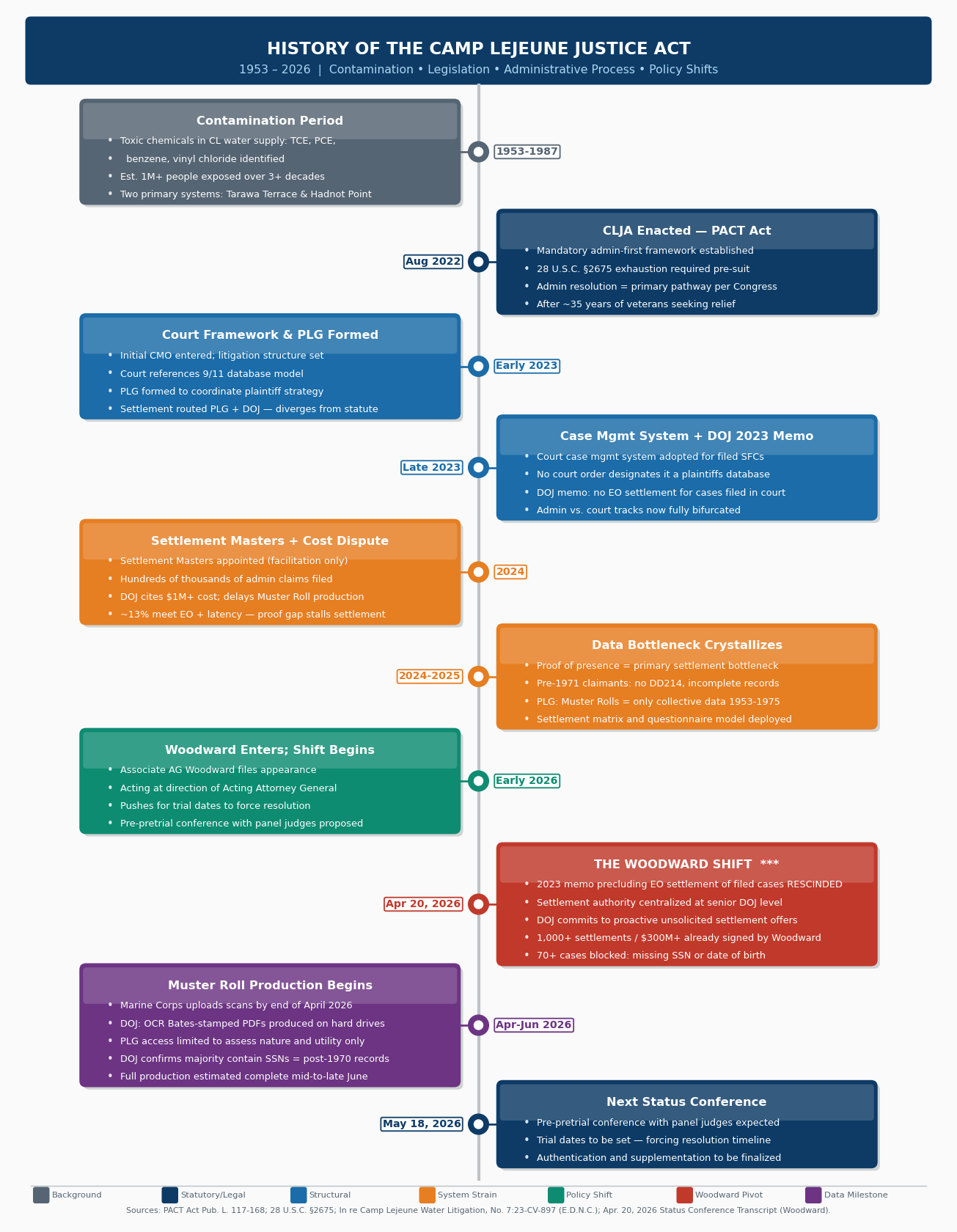
The timeline below documents the key milestones in the Camp Lejeune Justice Act’s history: from the contamination period through the decades of legal barriers, the CLJA’s enactment, the development of the administrative and litigation frameworks, and the April 2026 policy shift:
Part 7: What Changed on April 20, 2026 — The Woodward Announcements
A. Settlement Volume Prior to April 20
A DOJ press release dated March 10, 2026 reported that 649 EO offers had been approved in a three-week period, totaling $175 million. Since January 20, 2025, DOJ had paid more than $421 million in EO settlements. The cumulative total since the 2023 EO launch was reported as 2,531 approved settlements totaling approximately $708 million.[19]
On April 10, 2026, the DOJ’s official account posted that Associate Attorney General Woodward had visited the CLJA litigation team and described the litigation as “one of the most consequential litigations the Department has ever handled,” with over 409,000 claims submitted and a total claimed face value exceeding $335 trillion.[20]
B. The Three Policy Changes Announced at the April 20 Conference
On April 20, 2026, Associate Attorney General Stanley E. Woodward, Jr. appeared in person at the status conference before Magistrate Judge Robert B. Jones, Jr. in the Eastern District of North Carolina, accompanied by Deputy Assistant Attorney General Jonathan Guynn. Woodward stated he was acting at the direction of the Acting Attorney General.[18]
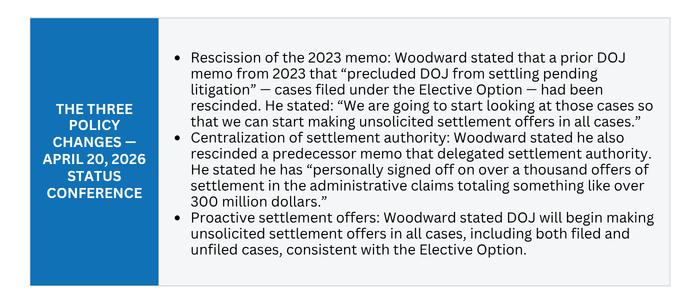
Woodward stated: “I have a genuine incentive and desire to settle those cases that are the most meritorious.” He further stated: “You won’t hear me say that we need the Court to rule on an issue to resolve a case … any case can be settled.”[18]
Woodward also stated that DOJ has “70 some cases where we don’t have a social security number and we don’t have a date of birth” and that “our team can’t make a recommendation about whether to settle those cases without being able to pull basic information from the databases.”[18]
Woodward stated his intention to attend a pre-pretrial conference with the panel of four District Judges and to have trial dates set: “If we set trial dates, we will get there.” The next status conference was set for May 18, 2026 at 11:00 a.m.[18]
Part 8: Summary of Current Status
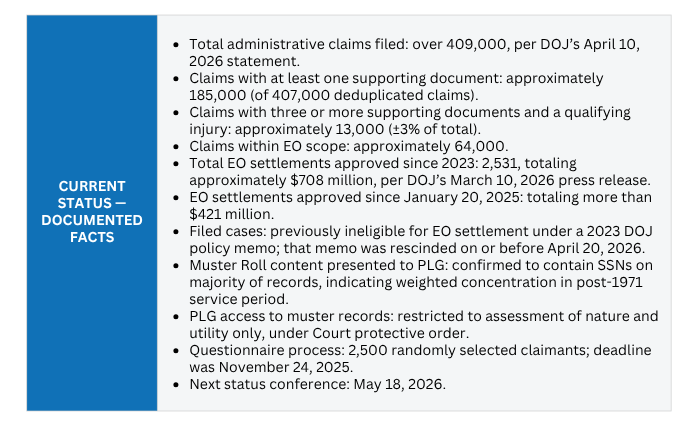
As of April 2026, the documented status of the Camp Lejeune litigation is as follows:
Part 9: What You Can Do for Your Clients Now
The bottom line is simple: the bottleneck in Camp Lejeune claims isn’t eligibility — it’s proof. While settlements continue to accelerate, too many valid claims risk stalling due to missing or incomplete documentation that the government has made clear it will not fill in for you. SimplyConvert’s Semper Fi AI was built to solve that exact problem, giving attorneys immediate access to a depth of historical records that simply doesn’t exist elsewhere and turning that data into clear, EO-ready substantiation. If you have Camp Lejeune clients whose exposure records are incomplete, Semper Fi AI can help you find and present the evidence needed to substantiate their time at the base.
For each client, the platform produces the Gold Form—a single, consolidated document built to meet the Navy’s requirements for substantiating EO claims. It includes a summary of the qualifying EO injury, a complete timeline of days at Camp Lejeune drawn from both DD214 records and documents in the Semper Fi AI database, and all supporting proof in a condensed format ready for direct upload to the Navy Portal. Instead of waiting on incomplete files or uncertain next steps, firms can now move cases forward with confidence, clarity, and speed — using Semper Fi AI today.

[1] ATSDR, Historical Reconstruction of Drinking Water Contamination at Camp Lejeune (2007 and subsequent reports). Primary contaminants confirmed: TCE, PCE, benzene, and vinyl chloride at Tarawa Terrace and Hadnot Point water treatment systems.
[2] ATSDR, Community Assistance Panel Reports and exposure assessment studies (1994–2014). Exposure estimate exceeds one million. Disease linkages documented in ATSDR mortality and morbidity studies.
[3] In re Camp Lejeune N.C. Water Contamination Litig., 263 F. Supp. 3d 1318, 1332–60 (N.D. Ga. 2016), aff’d, 774 F. App’x 564 (11th Cir. 2019). The MDL district court dismissed all pre-CLJA Camp Lejeune claims on three independent grounds: (1) North Carolina’s ten-year statute of repose, N.C. Gen. Stat. § 1-52(16); (2) the FTCA’s discretionary function exception, 28 U.S.C. § 2680(a), covering the government’s decisions regarding operation of the water systems and provision of warnings; and (3) the Feres doctrine, Feres v. United States, 340 U.S. 135 (1950). The Eleventh Circuit affirmed on all grounds. The CLJA addressed each barrier expressly: § 804(f) bars the discretionary function exception by name; the statute eliminates North Carolina’s statute of repose as a defense; and § 804(b) creates an explicit Feres exception. PACT Act § 804(b), (f), 136 Stat. 1802–1803 (2022).
[4] Camp Lejeune Justice Act of 2022, Pub. L. No. 117-168, § 3, 136 Stat. 1759 (Aug. 10, 2022). Administrative presentment requirement: 28 U.S.C. § 2675.
[5] Navy JAG Corps, CLJA Claims Management Portal, https://clclaims.jag.navy.mil. Camp Lejeune Claims Unit (CLCU), 1322 Patterson Ave SE, Suite 3000, Washington Navy Yard, DC 20374.
[6] Public Guidance on Elective Option for CLJA Claims, Dep’t of Justice and Dep’t of the Navy (Sept. 6, 2023; updated Sept. 15, 2023; FAQ updated Jan. 16, 2024). Affidavit insufficiency: Section IV. Irrevocability: Section VI. VA offset protection: Section V. One-condition limitation and diagnosis timing: Sections II–III.
[7] Navy CLJA, Help Me Find My Military Records, https://www.navy.mil/Camp-Lejeune-Justice-Act-Claims/Help-me-find-my-military-records/; Navy CLJA official guidance on creative documentation for proof of exposure. Service number to SSN transition: service numbers used through 1970; Social Security numbers adopted in military records beginning 1971, per DoD records policy history.
[8] Direct engagement with Navy and DOJ officials, September 2025. Participants: Commander Garrett Snow and Danielle Porcelli Bianchi (U.S. Navy); Bridget Bailey Lipscomb and Adam Bain (U.S. Department of Justice). Notes on file.
[9] Claim volume data: @TheJusticeDept, X (formerly Twitter), April 10, 2026 (409,000+ claims); Lawsuit Information Center, Camp Lejeune Lawsuit April 2026 Update, https://www.lawsuit-information-center.com/camp-lejeune-water-lawsuit.html (of approximately 407,000 deduplicated claims: approximately 185,000 include at least one supporting document; approximately 13,000 contain three or more supporting documents with a qualifying injury, representing approximately 3% of total administrative claims inventory within the government’s early settlement framework); Edwards Beightol Law, Camp Lejeune Justice Act Updates, https://www.eblaw.com/camp-lejeune-justice-act-updates (approximately 64,000 claims within EO scope).
[10] PLG and DOJ Joint Status Reports, In re Camp Lejeune Water Litigation, No. 7:23-CV-897 (E.D.N.C.) (2024–2025). The 12–13% figure is an estimate derived from claim screening data; it is not a formally published DOJ or PLG statistic.
[11] In re Camp Lejeune Water Litigation, No. 7:23-CV-897 (E.D.N.C.), Early Status Conference Proceedings (2023). Court reference to 9/11 Victim Compensation Fund litigation database as organizational model.
[12] In re Camp Lejeune Water Litigation, Questionnaire Order, Doc. 652 (Oct. 23, 2025) (Gates, J.), ¶ 6: completion of the questionnaire using the PLG’s litigation management platform “shall not require any claimant to sign a participation agreement with the PLG.” No court order designates the platform as a plaintiffs’ database or authorizes its use in the administrative process in that capacity.
[13] In re Camp Lejeune Water Litigation, Case Management Order No. 1 (E.D.N.C. 2023). PLG role described in CMO-related orders and court filings as coordinating discovery, depositions, bellwether trial preparation, and settlement negotiations for cases pending before the court. See also Krause & Kinsman, Camp Lejeune Litigation Update (Dec. 2024): “The PLG oversees discovery, helps choose trial cases, and participates in settlement negotiations.”
[14] 28 U.S.C. § 2678 (Federal Tort Claims Act attorney fee limitation): attorney fees shall not exceed 20% of any settlement or 25% of any judgment in FTCA matters.
[15] Camp Lejeune Water Litigation Common Benefit Attorney Participation Agreement, Doc. 31-3 (filed Oct. 26, 2023, E.D.N.C.). Section I.A.4 (EO carve-out for cases settled pursuant to Sept. 15, 2023 EO guidance); Section II.B.9 (3% holdback; allocation to be proposed by Plaintiffs’ Leadership and approved by Court prior to disbursement). No court order extends common benefit obligations to the administrative track or designates the administrative process as within PLG’s scope.
[16] Order, Doc. 652, In re Camp Lejeune Water Litigation (Oct. 23, 2025) (Gates, J.). ¶¶ 1, 2, 6. Scope: 2,500 randomly selected claimants. Deadline: November 24, 2025. Information received “shall be used for that purpose and no other.” Sanctions authorized for non-compliance.
[17] PLG Filings, In re Camp Lejeune Water Litigation (2024). PLG description of Muster Rolls as “the only collective data source” for Marines serving at Camp Lejeune 1953–1975.
[18] April 20, 2026 Status Conference Transcript, In re Camp Lejeune Water Litigation, No. 7:23-CV-897 (E.D.N.C.) (Mag. J. Jones). Court Reporter: Bobbie J. Shanfelder, RDR, CRR. Woodward statements: pp. 16–19. Mirsky (DOJ) on Muster Roll production: pp. 11–13. Wallace (PLG) on Muster Roll content: pp. 13–15. Woodward on 70 cases missing SSN/DOB: p. 18.
[19] Dep’t of Justice, Office of Public Affairs, “The Department of Justice Approves Historic Number of Settlements to Camp Lejeune Victims and Families” (March 10, 2026), https://www.justice.gov/opa/pr/department-justice-approves-historic-number-settlements-camp-lejeune-victims-and-families.
[20] @TheJusticeDept, X (formerly Twitter), April 10, 2026, https://x.com/TheJusticeDept/status/2042729130249380029.
DISCLAIMER: This publication is for informational purposes only. It does not constitute legal advice, does not represent the views of any party to the litigation, and does not create an attorney-client relationship. Individuals with potential claims should consult qualified legal counsel.